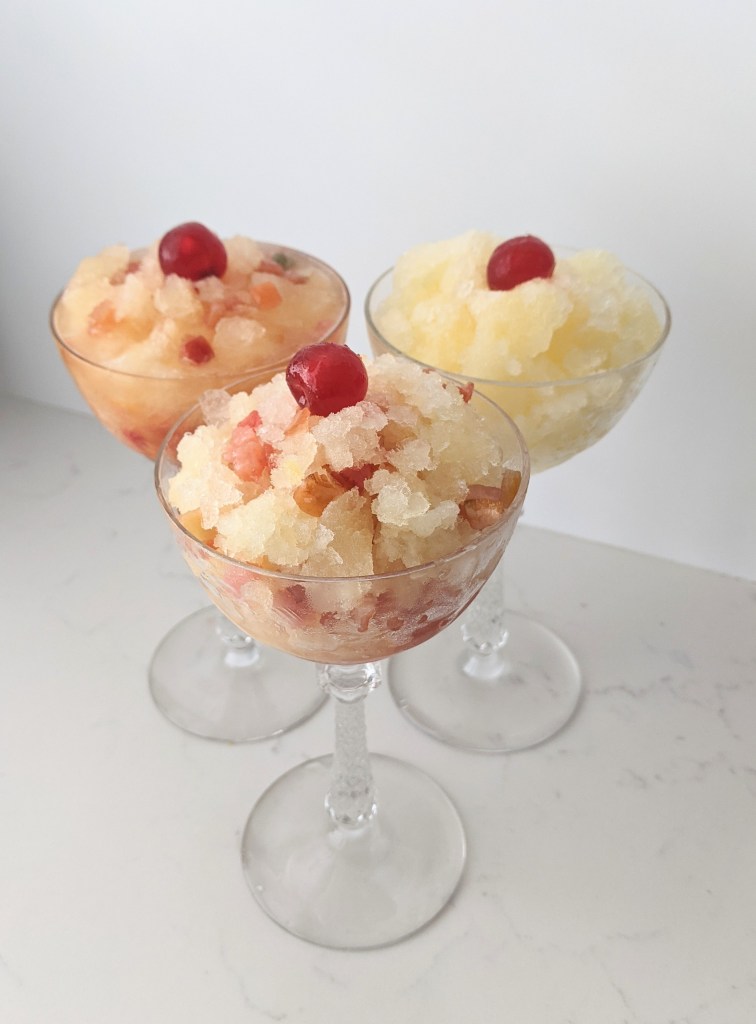
Italian Tutti Frutti
1 teaspoon unflavored gelatin
1 pound mixed candied fruit
½ cup cold water
1 quart hot water
Juice of three lemons (3/4 to 1 cup lemon juice, to taste)
Juice of four oranges (1 cup orange juice)
1 ½ to 2 cups sugar, to taste
½ cup dry sherry
1. Mince candied fruit, reserving a few whole cherries to use as garnishes, and soak all for several hours or overnight in sherry.
2. Dissolve the sugar in the hot water and boil together for twenty minutes.
3. Soften the gelatin for five minutes in the cold water and add to reduced sugar water.
4. Add the orange and lemon juice and freeze.
5. Before serving, set aside for up to a half an hour, then scrape with a fork or ice shaver, and mix in candied fruit.
6. Garnish and serve immediately in your fanciest dessert cups.
Original Recipe
Charles B. Knox Gelatine Co.’s Dainty Desserts for Dainty People, c. 1920
1 teaspoonful Knox Sparkling Gelatine
1 pound mixed candied fruit
½ cup cold water
1 quart hot water
Juice of three lemons
Juice of four oranges
2 cups sugar
½ cup sherry wine
Soften the gelatine five minutes in the cold water, and dissolve in the hot water and sugar boiled together twenty minutes; strain and cool; add the orange and lemon juice and freeze, then stir in the fruit cut fine and soaked several hours or over night in the wine. Set aside for half an hour, then serve in sherbet cups.
Comments: Now these were the flavors we were hoping to find in the Crown Jewel Dessert! And how about that elegant presentation? The granita (shaved ice) is light and fresh and the sherry-soaked candied fruit adds texture and color but not a dominating flavor.
One of the benefits of granita is its adaptability to your preparation schedule. It can be prepared several days to a week beforehand, and after it is removed from the freezer, it can be re-frozen if necessary to be served at a later date. This dessert has a sophisticated presence but is simple to make.
The flavor, too, is excellent. As my tasting team went back for seconds – without my prompting! – I did not think it necessary to change the amount or type of candied fruit in any way. We did determine that the candied fruit, while enjoyable, could be omitted to allow children or those who dislike the taste of sherry to enjoy the dessert, as the flavor of the granita is delightful on its own. If you are planning not to use the candied fruit, we recommend tasting the granita as you are making it so that you can adjust the flavor before the freezing process; you may want to increase the lemon juice to a full cup. We did, and we found that we liked the stronger flavor.
So, what’s in a name? I was curious about the name of this dessert, specifically because the flavors are, to my knowledge, primarily from the Mezzogiorno. The United States was not known for its fair treatment of Southern Italians in the 1920s (i.e. Sacco and Vanzetti), and I was wondering about the origin of the term “Tutti Frutti” and how the use of ingredients from traditional Sicilian street foods, like shaved ice and candied fruit, became acceptable in polite society.
It appears that the relationship between the dessert and any direct Italian origins is a bit tenuous. Through a bit of lazy research (Wikipedia!), I learned the dessert appeared, perhaps for the first time, on an 1860 menu in England, and since then, has been served more frequently outside of Italy than within it. Additionally, the height of its popularity may have been before the 1920s, as it appeared in New York City restaurant menus by 1900, some two decades before this booklet was sent to kitchens throughout America.
As for the Italian influence, candied fruit and wine-infused desserts are popular in Sicily and Italy, but those who enjoy the much-loved Sicilian granita will attest that the addition of solid fruit or nuts are not common today. I do not believe this is a change from the past, so perhaps the rhyme within the Italian phrase was the primary reason for it continued use to describe this and other colorful desserts.
Finally, I’d also like to add that the candied fruit I purchased from Amazon, Paradise Holiday Fruit, was sweet but not saccharine. It is suitable for this American recipe, though I can also imagine how a higher quality candied fruit from Italy – made with Italian fruit or vegetables – could be substituted to provide an even more layers of flavor.
 Don't Break the Mold